Wednesday, November 25, 2015

The Hunger Games

By: Håvard

The Hunger Games is a book written by Suzanne Collins where we get to read about a dystopian world. The action takes place in “Panem”, a country that rose from the ashes of North America. Panem has a very particular system. There is a government that is placed in the Capitol, and it has a strict regime they use to hold the “districts” in check. It is twelve districts, which each of them has a function to the Capitol. Each district produces something different for the Capitol. There used to be thirteen districts, but district 13 rebelled and was destroyed by their government. After this, the Capitol started The Hunger Games.

Each year, two of the children from each district is “reaped”. This means that they have to leave home and partake in a televised battle to the death with the kids from other districts. The protagonist of the book, Katniss Everdeen, volunteers for the Games when her little sisters name is pulled at the reaping in district 12. Now she and the boy from the district, Peeta Mellark, has to go to the Capitol and participate in The Hunger Games.
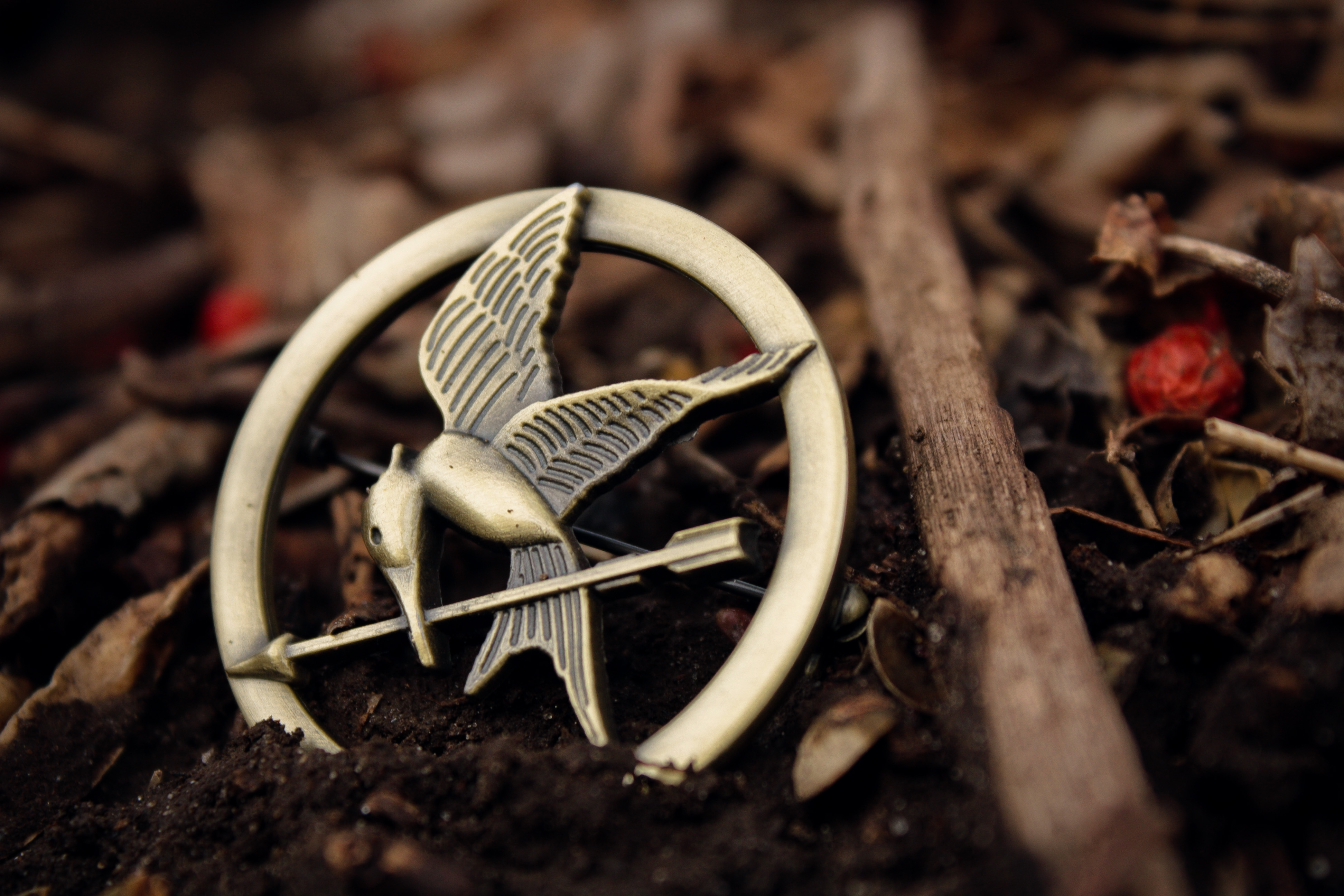
This book has many themes and values that teenagers can relate too. Some of them are love, friendship and the need to stand up against the authorities. When it comes to standing up to authorities, teenagers often feel that the “grown-ups” treat them unfairly and Katniss is a protagonist that stand up and fights. Love is also a big part of the story, where Peeta is in love with Katniss, but she does not answer this love. This is something many people can relate to, not just teens. The friendships Katniss forges inside the arena, especially with Rue, is something that can touch the readers as well. In addition, when she dies, it shows the reader the hardships of dealing with loss.


It is a book that can capture people’s interest and make them realize that reading books is not necessarily a boring activity.

Sources:
Collins Suzanne (2008) The Hunger Games, Scolastic Ink, Broadway, New York 

https://www.flickr.com/photos/brokendownlover/6608549961

Authorities in Dystopian Literature - The Hunger Games

By Elias Stenersen

The book The Hunger Games is the first book in a trilogy, written by Suzanne Collins. The book is a so-called dystopian novel, which can be defined as “A fictional, socially engineered society usually presided over by a totalitarian regime” (Gamble, 2013, p.200).

In The Hunger Games, the socially engineered society is Panem. President Snow is the ruler of Panem, and his regime is exactly as you might think a totalitarian regime is. The totalitarian regime enforced by President Snow and his government is more or less a dictatorship.

As early as page seven in the book, we read that in Panem the government does not allow free speech. Katniss tells a story from when she was young and used to “blurt out about District 12, about the people who rule our country…” (Collins, 2008, p.7). Katniss goes on to explain that she stopped criticizing the regime in public, after she realized she could get in trouble if she didn’t stop.  

https://www.flickr.com/photos/goodncrazy/4350445408
Later in the book, another key aspect of dystopian literature is present. At the end of chapter one, the reasons behind the creation of the Hunger Games is revealed. The games were created to remind Panem’s citizens of the power of the regime. This yearly reminder of what Snow and his government is capable of is meant to kill all thoughts about rebellion against the authorities.

Snow and his strict regime use another very direct way to control the citizens of Panem. Peacekeepers are armed forces stationed in the Districts in order to control the masses and spread fear. Rue from District 11 tells Katniss a story about a boy who was shot for trying to keep his pair of see in the dark glasses.


The idea of authorities not allowing free speech, individual thinking and using fear to control the masses are typical features of the authorities or governments found in dystopian literature.

Hunger Games in the classroom

Writer: Håvard

This post will be about how you can use literary texts when teaching English. More accurately: The Hunger Games. This book can be able to grab the pupils’ attention and make the English lessons more interesting. It is a work of fiction, but has its roots in problems that we deal with today. This is why I believe it can be a useful and effective tool when teaching.

When using this kind of book, it is important that you get the pupils to read it. There are different solutions as to how to work with this. You can give them a set period to read the whole book, and then discuss it. Alternatively, give them a number of pages as homework and work through the book together in class. Using this book, that is not a traditional “boring” schoolbook, it is a possibility of peaking the interest of the pupils and make them more motivated to read even more books in their spare time.

In Anna Birketveit and Gweno Williams book: “Literature for the English classroom, theory into practice”, they have a chapter about novels for teenage readers. They list some aims and methodology that is useful when working as a teacher. I will list two of them here.
1
  • .       “To suggest and encourage a passion for reading in the English classroom.
  • .       To highlight what is distinctive about teenagers, thereby increasing understanding of the types of reading matter and themes which might appeal to them most”. (Birketveit and Williams, page 165)

Both of these show that it is possible, and that these type of books can be used effectively when teaching English. If this can be a stepping-stone for the pupils to read more books in English, I believe that it is appropriate to use them.

Sources:

 Birketveit, Williams, 2014, Literature for the English Classroom, Fagbok Forlaget, Bergen

https://www.flickr.com/photos/onourminds/6173966553

Matilda

Matilda Is a book written by Roald Dahl in 1988. Tha book is about a super inteligent girl with special powers who lives with her family who don't care about her or education. At school she meets the wonderful and kind teacher Miss Honey, and the terrible headmaster Miss Trunchbull.

The book has several themes and one of them is children who rebels against authority (in this case the parents and miss Trunchbull). Another theme in Matilda is family, Matilda knows that her family isn't normal and show us what a dysfunctional family is. We take it for granted that parents are loving, kind and suportive. Miss Honey has also a dysfunctional relationship with her aunt Miss Trunchbull. A third theme you can find in the book is authority abusing power. Mis Trunchbull abuses her children by throwing them around, locking them in and forcing them to eat cake. At last but not least we have the theme "superpowers", Matilda is not only super smart but she also can move things by using her mind. How cool is that?

- by Karita Hansen

Panem: A dystopian society

By: Martine Olsborg

The Hunger Games has become a world famous YA-series, and all three books have been adapted into movies. The series is written by the American author Suzanne Collins. The story takes place in “the Hunger Games universe”, and it is set in the country “Panem”. Panem is a dystopian society, and we will now look at what makes Panem a dystopian.

First of all, what is a dystopia? Nikki Gamble describes dystopia as “a fictional, socially engineered society usually presided over by a totalitarian regime” (Gamble, 2013, p. 200). One of the most characteristic things about a dystopian literature is that the humans are the cause behind the dystopic state. A dystopic state can have similarities with the world we live in, but it is usually set in an imaginary future. It is a very restricted society where you have a superior authority that controls the rest of the citizens. (Gamble, 2013, p. 200)

So what about Panem? After national environmental disasters and war, North America was destroyed. Panem raised from the ashes and became a country. Humans where therefore the reason behind the evolving of this state. Panem is placed at an unknown time in the future, as dystopias often are. It is divided into 12 districts, and Panem’s source of power lies in a utopian city called “the Capitol”. The different districts are built on class divisions and they are not allowed to have contact across the districts. The society is built as a pure dictatorship with “President Snow” as the one in charge. He and his “peacemakers” makes sure that the citizens don’t contact other districts. This is to avoid that the people in the districts comes together in a new rebellion. The society is living in hunger, but in the Capitol people are eating more than they need. The fact that nobody can take a stand against the injustice in Panem, says a lot about how much power the government has and how much power they use to keep people from rebelling.

As you can understand, Panem is a very controlling society and it does not give the citizens much freedom. It is an unfair life how the people in the different districts lives. It is truly a dystopia and I’m just happy that I don’t have to take place in a society as Panem. 

Sources
- Gamble, Nikki. Exploring Children’s Literature. London: Sage Publishers, 2013
- http://www.flickeringmyth.com/wp-content/uploads/2014/11/The-HUnger-Games-Movie-Logo.png

Romeo and Juliet in class


Shakespear is a Writer and a poet who many of us has heard of, he has written some of the most famous plays and sonnets. One of them is Romeo and Juliet, for those who don`t know the play is about two young lovers who can`t be together because of their families and their feuds. The play is used in many secondary schools for teaching purpose, because of it`s relevance.


I`m going to show you two ways of using Shakespeare`s Romeo and Juliet in class. Because of the sometimes-difficult language, I have chosen to give you examples of teaching Romeo and Juliet to 10th graders because it might be easier to understand for them. 

The first example is to set up the play, you can do that by dividing the class into five group, where each group has to play one of the five acts (this depends on the size of your class). That way you don`t have to make every pupil read the whole book. Each group read just their own act, and then have the chance to discuss the language, and what some of the words means.  If you want to make it a big project you could make them film their act, that way it don`t feel so scary to show it to the others. It`s worse to perform it live than showing your classmates a movie. You can also decide if you want them to perform the play as it is, or let the pupils make a modern version. 


Another way is to show them the movie from 1968 by Director Franco Zefirelli, and then divide them into groups where each make a poster about how it was for people living in Shakespeare’s time. What they wore, what kind of social rules they had, if there is any likeness to today`s society. This way the pupils get a deeper understanding for the play, because they know more about what kind of time the characters lived in.


Sources
http://www.imdb.com/title/tt0063518/
https://simple.wikipedia.org/wiki/Romeo_and_Juliet
https://en.wikipedia.org/wiki/William_Shakespeare

By Karita Hansen

Using Fairy Tales in a Teaching Situation

By Vegard Melum


In this blogpost we will be looking at pros and cons with fairy tales, the structure of the tales and an activity we can use in class to further our knowledge about fairy tales in general.

A traditional fairy tale has certain pros and cons. According to Anna Birketveit and Gweno Williams (“Literature for the English classroom – Theory into Practice”, 2014:93-) a traditional fairy tale has certain pros and cons. Here are two lists of pros and cons mentioned in the book, that answers the question, “Why use fairy tales in a teaching situation?”:

The Grimm Brothers
Pros
·        The plot and characters of the tales are often familiar
·        The tales follow a fixed pattern
·        By reading fairy tales the pupils can deal with longer texts
·        The vocabulary is simple (everyday language)
·        Actions, situations and phrases are repeated

By following a fixed pattern the story enabled the learners to guess meaning of unfamiliar words. By repeating actions, situations and phrases, it will re-inforce language learning. Also, because the stories are pretty much the same in Norwegian and English, fairy tales makes it easier to compare the two languages and to guess meanings.

Cons
·        Many of the tales has outdated values and morals
·        They may promote stereotypical gender roles

Ever since Charles Perault (1697), the Grimm Brothers (1858) and Asbjørnsen and Moe (1871) started writing and collecting fairy tales, they have been changed and adapted to the new culture and society. Take for example “Sleeping Beauty”. In the original fairy tale by Charles Perault, Sleeping Beauty was raped while being asleep, and woke up giving birth. Now a days the tales aren’t that grotesque. This is because they are changing along with the society we live in. You can’t just tell a kid today about a princess being raped. That is why Birketveit and Williams states that many fairy 
tales has outdated values and morals.

To make the pupils work with both the old and the adapted versions of the common fairy tales, they need to do some activities. A fun activity you can do with pupils in the lower secondary is having the students make two versions of the same fairy tale. First, they will write a “modern” fairy tale, as the ones we read and use today. Second, they will use the fairy tale they wrote and then write a more grotesque version of it. Like the ones the Grimm Brothers collected and wrote in the 1800s.
To write a fairy tale, the pupils has to follow a narrative structure used in the fairy tale genre:

·        Opening: “Once upon a time”
Sleeping Beauty
·        The focus should be on a leading character
·        Contrast: The characters are either good or bad
·        Twins: Some characters share the same traits
·        Magic numbers, such as 3, 7 and 12
·        Final stress: The act that brings a solution
·        Closing: “They lived happily ever after”

The fairy tale should have a fast moving plot, where the telling is simplified and details are eliminated. Stock characters are common, and the tale should have a principal massage with an optimistic worldview. This could be for example: life involves a struggle, but be good and you will be rewarded.


Happy story writing!

Birketveit, Williams, 2014, Literature for the English Classroom, Fagbok Forlaget, Bergen