Friday, September 4, 2015

Analysing the illustrations in Matilda: Miss Trunchbull.

Analysing the illustrations in Matilda: Miss Trunchbull.

By: Kristian Granås


Matilda
by Roald Dahl is a book about a small child named Matilda who possesses an extraordinary power, and her struggle dealing with her family at home and the principal, Miss Trunchbull, at her school. Roald Dahl describes Miss Trunchbull in an excellent way with the use of his words, however this text will focus on the how the illustrator Quentin Blake uses his illustration to make Miss Trunchbull a mean character that all the child and adults alike fear.

So how does Quenting Blake and Roald Dahl use illustrations to make Miss Trunchbull a fearsome character?

Introducing Miss Trunchbull.
p. 1.
In the very first page of the book there is an illustration of the all characters that play a part in the story. The illustration of Miss Trunchbull is different to say the least! Miss Trunchbull has a stern expression in her face, and is in fact the only person to look quite unhappy of all the 8 characters being introduced. So the readers get to make an early assumption on how Miss Trunchbull acts just by looking at the first page.


Amanda Thripp vs. Miss Trunchbull.

 
 p. 107
This next illustration shows Miss Trunchbull standing over a quite baffled girl named Amanda Thripp. In this illustration you can clearly see the enormous size of the Miss Trunchbull, especially if we are comparing her to the small Amanda Thripp. Miss Trunchbull is also pointing a huge finger at the girl, so you can assume that the girl supposedly did something the vast giant didn’t adore (in this case it was because Thripp had her hair in pigtails).


Miss Trunchbull, the former athlete. 


p. 108 and 143.

These two next illustrations display Miss Trunchbull demonstrating her brute force. The two pictures also shows terrified children in the background, while Miss Trunchbull is punishing another child. This is obviously a quite scary illustration, and it is understandable that the children in the background (and maybe even the readers) are terrified.  

Although both pictures show off a mighty principal, I find the first illustration most fascinating. Miss Trunchbull is actually smiling! She is obviously quite happy and satisfied by spinning the small girl above her head (before she throws her out the window). I believe this just emphasise her hatred for small children, and her exhilaration by showing off her former athlete strength. It is no big mystery that Miss Trunchbull, only by looking at the illustrations, is a most fearsome character.


Sources.

Dahl. R (1988) – Matilda –
Puffin Books.

Motivating young pupils for reading Matilda.

Motivating young pupils for reading Matilda. 

By: Kristian Granås.

Matilda
by Roald Dahl is a world famous children’s novel published in 1988.  Matilda is the story about a child with unusual powers and her struggle dealing with her family at home and the principal at her school.

Pre-reading strategies.
This text will focus on the pre-reading strategies a teacher can use to boost pupils motivation when working with Roald Dahl’s Matilda. There are several different pre-reading strategies to use. These are the two strategies I have focused on:
- Discussing the pictures in the text and the cover of the book.
- Make the pupils aware of the main plot in the story.


Discussing the pictures.
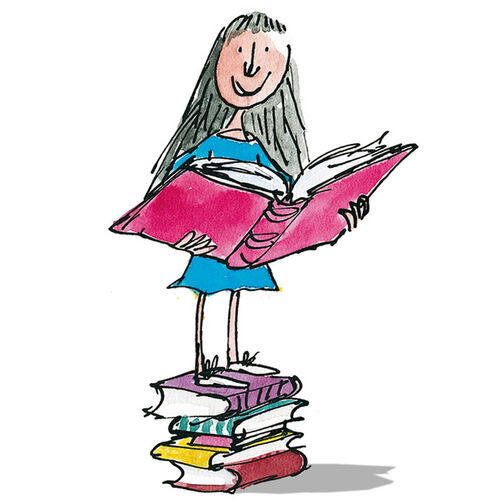
It can be difficult for the pupils to get motivated if they don’t know anything about the story before they start reading. The use of pictures, both on the cover of the book and inside the text is very important I believe. Most young pupils will pick a book or a text based on the pictures and drawings in the book, because the illustrations is probably the first thing they notice. By discussing these pictures, the pupils can describe what they see, and then take guesses on the plot of the story.
The pupils can then start reading, to see if their guesses were correct or not. (Munden, 2014, p. 263).


 Example: Matilda is standing on top of several books, and reading one herself. Does she enjoy reading? Maybe she just wants to be taller? Or can it be another reason?


Discussing the plot.
Another good pre-reading strategy that can be helpful is discussing the plot. An idea is to make sure the pupils know a bit about the main plot. Furthermore the teacher can give them an assignment to write down a couple of questions the pupils want to find out about the story. Or the teacher can make a quiz, asking the pupils question on what they think is going to happen in the story. This is a method that is quite effective.
“…They were asked to rate on a scale of 1 to 10 how effective it was at getting them to do the reading. The required techniques (quizzes, answers to questions about the reading, and short writing assignments) were the most effective, with mean evaluation scores of 7.85 or higher.” (Weimer 2015)


The urge and curiosity from these questions can help build their motivation to start reading. A continuation of this idea is to discuss these questions with the entire class. Most likely will there be a lot of different questions from the pupils, and the questions asked by the other pupils may inspire them.   

Another argument is the fact that this story takes place in both a school and a home environment so it will be quite similar to the pupil’s own life. The struggle dealing with difficult parents and stubborn school-workers can be quite interesting for a lot of children to read. Making the pupils aware of that before they start reading will most certainly trigger their interest.


Sources.
Dahl. R (1988) – Matilda – Puffin Books.
Munden. J (2014) – Engelsk på mellomtrinnet – Oslo: Gyldendal akademisk.

Weimer, PhD (2015) - Getting students to do the reading.
http://www.facultyfocus.com/articles/effective-teaching-strategies/getting-students-to-do-the-reading/